
Montgomery Projected Release Dates
TDCJ’s Projected Release Date is a classification-and-records calculation. It estimates when a person may leave incarceration if parole does not happen sooner. It is not a court promise, parole approval, or an actual departure time. Later, Scheduled Release date and location fields may appear, but TDCJ warns that they can change while staff complete audits, program checks, release-plan review, certificates, and hold checks.
A Montgomery County projected release date applies only when TDCJ owns the calculation. A person in Montgomery County Jail follows the court commitment, jail credit, local law, and any holds. No Montgomery-specific public good-time or weekend-release policy was verified. Request the jail calculation instead of applying state-prison formulas to a county sentence.
| Field | Meaning |
|---|---|
| Parole eligibility | First point for review, not release |
| Projected release | TDCJ calculation if parole does not occur first |
| Scheduled release | Later processing field that can still change |
| Actual release | Recorded departure on parole, MS, transfer, or discharge |
Find Montgomery Release Dates
The TDCJ offender search accepts name, TDCJ number, SID number, gender, and race. It requires a TDCJ or SID number, or at least a last name and first initial. Surname matching is exact. It includes only people currently incarcerated in TDCJ. A person who has left state custody may be absent, so no result is not proof of discharge.
- Confirm TDCJ is the custodian, not Montgomery County Jail, BOP, or ICE.
- Search by TDCJ or SID number when possible.
- Match identifiers, age, conviction county, and unit.
- Read projected release separately from parole eligibility and maximum expiration.
- For confirmation, contact TDCJ with the exact identifiers.
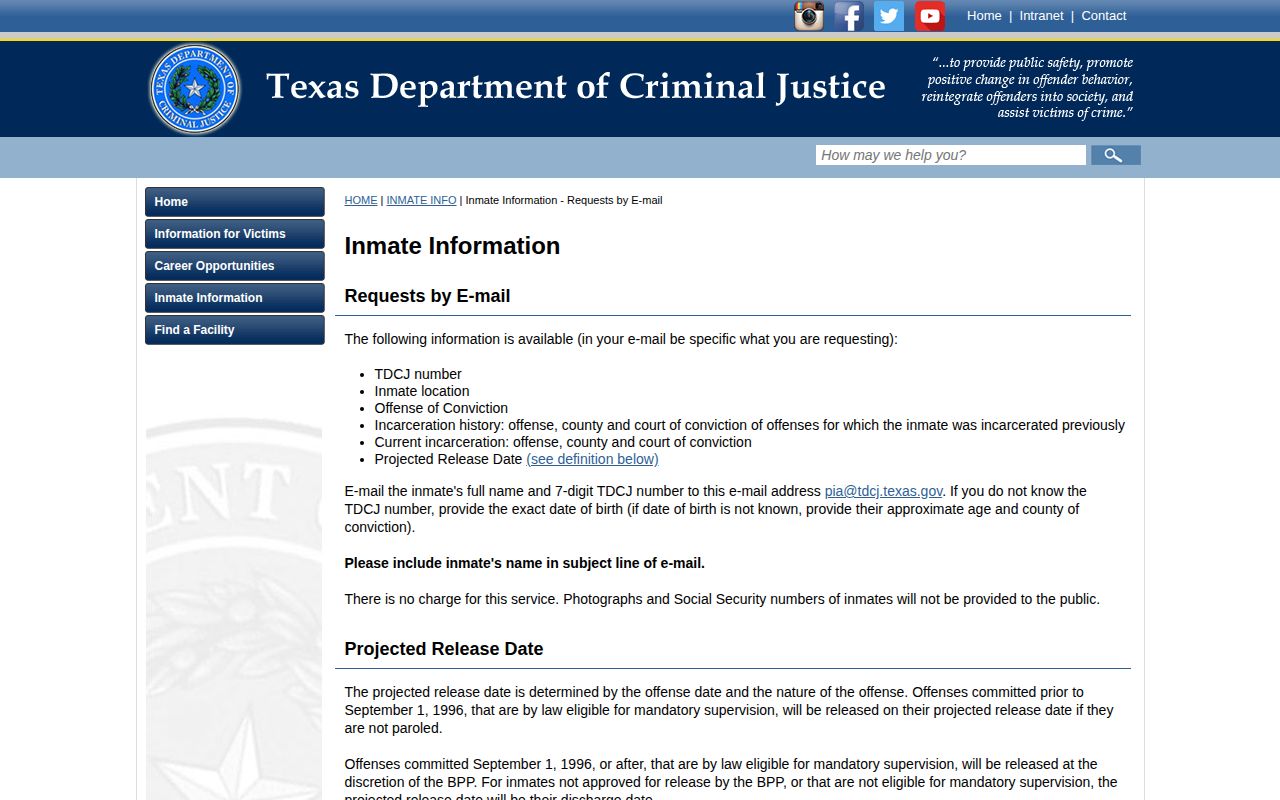
Call 936-295-6371 or 800-535-0283 from 8 a.m. to 5 p.m., Monday through Friday, or email pia@tdcj.texas.gov. Review TDCJ’s requested fields before sending the inquiry.
The field list distinguishes a projected calculation from an actual release date.
Texas Good Time Rules
Good-conduct time depends on classification, conduct, and qualifying participation. It can be earned, forfeited, and sometimes restored. Texas Government Code §498.003 governs earning and classifications, while §498.004 covers loss and restoration. Good time does not reduce the judicial sentence and does not guarantee release.
Texas has no blanket 85-percent rule for all state prisoners. It uses offense-specific law. Under §508.145(d), some covered offenses generally reach eligibility when actual time, without good time, equals the lesser of half the sentence or 30 years, with at least two actual years. Other subsections differ. Ordinary eligible cases under subsection (f) may use actual plus good time equaling one-fourth of the sentence or 15 years, whichever is less. Offense date and the governing statute control.
- Flat time
- Actual calendar time served.
- Good time
- Administrative credit based on status, conduct, and qualifying activity.
- Detainer
- A hold from another authority that may block or redirect departure.
- Discharge
- The end of the sentence, not merely release from a facility.
Why Montgomery Dates Change
New credits, disciplinary loss, restored time, consecutive sentences, detainers, corrected judgments, program requirements, and records audits can move a date. Board action matters too. For applicable post-1996 cases, discretionary mandatory supervision depends on BPP approval. A denial may move projected release toward maximum expiration. Later approval can move it earlier.
| Change | Possible effect |
|---|---|
| Discipline | Loss of credit |
| Program requirement | Release waits for completion |
| Detainer | Transfer or delayed community release |
| BPP action | Approval, denial, or later review |
| Records audit | Correction of calculated fields |
Eligibility opens review only. Even an approval code does not prove departure. Compare the latest TDCJ field with the judgment and ask whether the date is projected, scheduled, or actual.
Confirm Montgomery Actual Release
For TDCJ, obtain the actual parole, MS, release, or discharge date through inmate information or a TDCJ records request. If local supervision continues, contact the Conroe District Parole Office at 4301 South Loop 336 East, Conroe, TX 77301, phone 936-756-0420.
For Montgomery County Jail, call 936-760-5800, select jail option 1 and inmate-information option 5, or email mcsocjr@mctx.org. Request the booking-out sheet through the MCSO portal. It can establish date, time, disposition, and receiving agency. Use the VINE Inmate Check for alerts and the county release-record path for proof.
Mandatory Supervision Date Effects
For an offense before September 1, 1996 that is eligible for mandatory supervision, TDCJ describes projected release as the point when actual time plus good time equals the sentence, if parole has not occurred. For an eligible offense on or after that date, the arithmetic also depends on BPP approval under discretionary mandatory supervision. If the board denies MS, TDCJ may recalculate toward maximum expiration or discharge. A later favorable review can change the display again.
People who are legally excluded from mandatory supervision follow a different path. Their projected date generally aligns with maximum expiration based on flat time unless parole happens first. Government Code §§508.147 and 508.149 govern mandatory supervision and exclusions. The live statute and the offense-date version matter more than a simplified offense list.
Montgomery County Jail Calculations
A pretrial detainee has no sentence-based projected date. Release can turn on bond, a signed court order, dismissal, another pending cause, or a detainer. A locally sentenced person may have jail credit, but the court commitment and MCSO calculation control. The state prison formula is not a shortcut for either situation.
Ask MCSO for the named booking’s calculation and release sheet. Include the full name, booking number if known, case number, and date range. Ask for the actual booking-out date and time, plain-language disposition, releasing authority, and receiving agency if transferred. If the response shows a transfer to TDCJ, begin the state search under the TDCJ or SID identifier. If it shows community release, the court docket can explain the authority even when it does not show the exact minute of departure.
A bond authorization can precede physical release while staff check other cases and holds. A TDCJ commitment can remove a name from the county roster without community release. These distinctions make the actual record more useful than a calculated date alone.
Montgomery Parole Review Dates
Parole eligibility is a review threshold, not a release appointment. The Texas Board of Pardons and Paroles identifies cases for review in advance, and a panel can approve, deny, or set later review. Texas does not conduct a formal release hearing for each parole or mandatory-supervision case. There is no person-by-person public hearing calendar that replaces the TDCJ record.
Vote codes need context. FI-1 calls for release when eligible, while other favorable codes may set a future date or require a program before release. A denial may set a later review or require service of the remaining term, subject to any mandatory-supervision process. Even after a favorable vote, TDCJ may still need an approved release plan, program completion, certificate work, a records audit, and resolution of holds. Call BPP status at 844-512-0461. After approval, Review and Release Processing can address release status at 512-406-5202.
Eligibility answers when review may begin. Projection estimates departure under the current calculation. Scheduling reflects a later operational plan. Only the actual release record shows that the person left TDCJ custody.
Montgomery Release Date Records
TDCJ's public-information policy identifies post-release fields that can resolve an old or changing result. A focused request may seek sentence dates, parole eligibility, parole or mandatory-release dates, current parole or MS status, discharge date, and parole warrant information. Include a TDCJ number or SID when known. Without an ID, provide the exact date of birth or approximate age and the county of conviction.
The general inmate-information email is a convenient first route, but a formal records request is better when an official document or broader release history is needed. Ask separately for actual release, release type, parole or MS date, and final discharge. Those fields mark different stages and should not be collapsed into one date.
A result can remain accurate even when it changes. Good-time classification, lost credit, a corrected sentence, a consecutive term, a detainer, a board decision, or a records audit may alter the current calculation. Record the date on which a projected field was viewed, then confirm again close to anticipated departure.
For a Montgomery County conviction, the county of conviction helps TDCJ distinguish similar names. The release facility may be elsewhere because no TDCJ prison unit was identified inside Montgomery County. Do not infer that a local conviction leads to a local prison release. TDCJ assigns people statewide, and the current unit or scheduled release location must come from the live state record. After departure, request the actual release and supervision fields rather than relying on an old screenshot.